 |
 |
 |
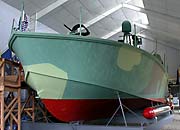
PT Boat PT-796 (Higgins)
PT-796 is a Higgins class PT Boat. PT-796's specifications are:
Length: 78 feet
Beam: 20 feet 8 inches
Draught: 4 feet
Crew: Two officers and nine crewmen
Displacement: 43 tons empty, 48 tons fully loaded
Max Speed: 41 knots (46mph)
Fuel Capacity: 3,000 gallons of 100 octane avgas
Range: 358 miles at 35 knots, 1050 miles on one engine, 11 knots
Oil Capacity: 30 gallons
Armament:
Four 21 inch Torpedoes
Up to 8 Mark 6 300 pound Depth Charges
Two 20mm Oerlikon AA guns
One 40mm Bofors AA mount aft
Four 50 cal. Browning Machine Guns
Hull Construction: Double planked Mahogany (NOT plywood)
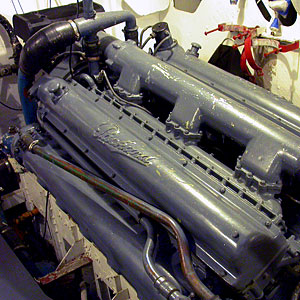
Power Plant: Three 1,200 hp Packard V-12 engines driving 3 propellers with 3 rudders
Launching Date: May, 1945
You can see the Higgins PT Boat PT-796 at the Battleship Cove Naval Museum in Fall River, Massachusetts. PT-796 was the last PT (Patrol Torpedo) in operation by the US Navy, seeing active service until the early 1960s. It is missing some of it's original fittings but the museum staff is working to correct that. One staff member has begun construction of new 50 Cal machine gun tubs. My guide that day was Jack Madden, a PT Boat Veteran who served on board a Higgins during his tour of duty in the Mediterranean during WWII.
Higgins Planking
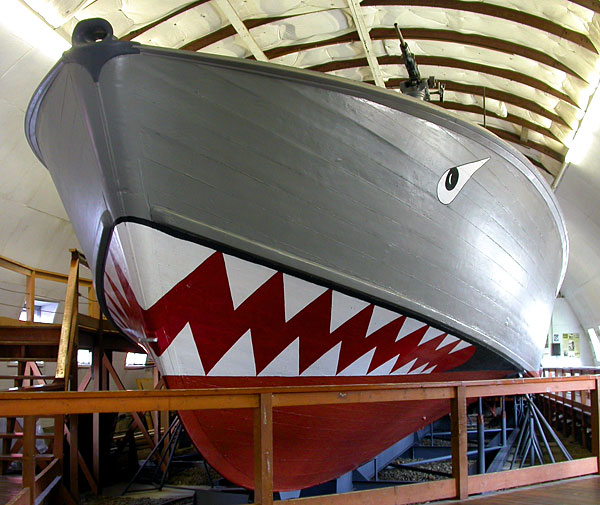
Jack felt that at some point in its life it may have been re-planked incorrectly. The hull of PT-796 is double planked mahogany (NOT plywood, although they are often referred to as plywood boats). The two layers of mohogany planking normally run diagonally opposite each other with a sheet of glue impregnated canvass sandwiched in between. From the interior views of this Higgins you can see that the interior planking is done diagonally as is normally done, but the outer planking is not as what we had seen in the books detailing the construction of PT Boats that both Jack and I have. You can see from the external views that it is planked longitudinally. That conclusion made sense until I received the following note from Jerry Gilmartin, the curator for the PT 658 museum located in Portland, Oregon (they have a working running Higgins PT Boat). Jerry set us both straight on the mystery of the horizontal outer planking on this Higgins PT-Boat. Jerry writes:
"It is true that on early PT Boats such as the PT309 in Texas , that the outer planking was diagonal, and both layers were mahogany. Then the Higgins Industries boatyard changed their methods during the later war years (1944-1945) and started planking the outer layer with 3/4 inch horizontal layers. This scheme is identical to the method used on PT658. The makeup of the wood is also different, (I think it was because they were running out of mahogany?) but the inner layer is 5/16 inch thick fir (or spruce) laid diagonally and then the layer of glue impregnated canvas, then a 3/4 inch layer of mahogany laid horizontally and joined together end to end with screwed "butt blocks" aka "fish plates" on the interior of the boat. These blocks hold the end butt joints together of the horizontal strakes of planking. Holding both interior and exterior layers together besides the glue, are thousands of copper rivets and bronze flathead countersunk and bunged screws. I am not sure why Higgins went to this different method of planking the boats, and I suspect that it occurred around the 400 series of boat hull numbers. The higher numbers were all horizontally planked on the outside and the lower numbered boats were diagonally planked on the outside. Pretty minor fact, but at least now you know. " Jerry also wrote that the change of planking for the Higgins boats began in late 1944.
Don Shannon of the Battleship Cove Museum adds:
"To the best of my Knowledge the answer from the Portland crew is correct but it was only the very last Higgins boats on the production line that were built with the exterior horizontal planking. Our PT 796 does not indicate that the planking was changed from an inspection of the boat from the inside, the inner planking is believed to be original and has no signs of extensive rework that would have incurred if the entire exterior plank was changed therefore the plank was laid longitudinal in the boat yard. One Interesting fact is that PT 659 that was built for lend lease to the USSR, and later found by the Portland group that restored PT 658, then sent to a Washington restoration group and now to the WWII D Day museum in New Orleans has the vertical planking above the water line typical to most of the WWII PT Boats. "
So the bottom line is that the later Higgins boats for some reason were planked horizontally on the outside from late 1944 onwards.
Higgins Torpedo Tubes
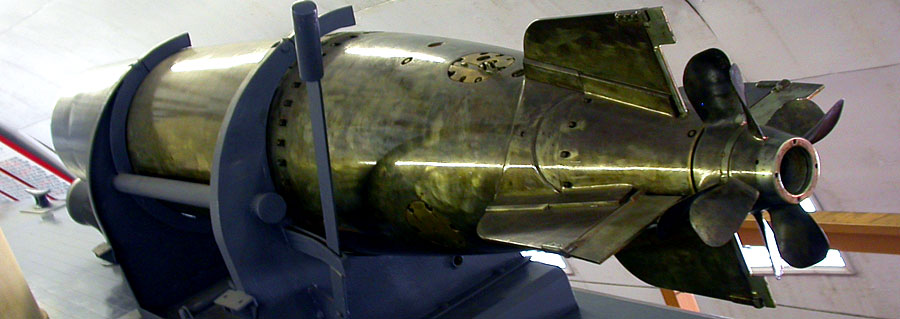
Jack also told me the story of the simpler torpedo mount you see above. Originally the boats used long heavy tubes for the Mk VIII 21" torpedo on either side of the deck. To launch the torpedo it needed to be started up and their gyros set, then the tube would be swiveled out on an angle to allow the torpedoes to clear the deck when launched. The torpedo would then be launched out of the tube via a reservoir of compressed air. If this system failed a crewman would strike a percussion charge trigger with a mallet setting off an explosive charge to fire the torpedo. At night that was a big drawback as the flash blowing out the front of the tube illuminated the boats and their positions. However Jerry Gilmartin wrote to set me straight on this that the earlier Higgins boats using tubes to launch their torpedoes never used the percussion charges. Jerry writes:
"The old PT boat torpedo tubes were two different types, one using compressed air ( mostly on the Higgins 78 footers) or the Powder impulse charge tubes ( mostly in use on all Elcos ) The Higgins never used a powder charge, only air. All of the tubes were greased on the inside, however, to help the torpedo slide out of the tube better. Mostly, it was only an Elco problem with the black powder impulse charge igniting the grease and causing a telltale "flash". The primary method of launching the Elco torpedoes was by pressing a remote electric "firing button" on the bridge, and if that remote firing method failed, then a crewman stood by the torpedo tube with a mallet to strike the percussion charge with the mallet to set it off as an emergency backup method of launching the torpedo. The Higgins tubes had a large curved air reservoir on top of the tube, and they also had an air compressor down below in the engine room that I think could be used to refill the air reservoirs on the tubes. I am pretty positive the Higgins Air launched torpedo tubes never had any form of black powder backup system. "
Torpedo Racks
I had read in the book "American PT Boats at War" (Pg 110 - an excellent book) that a couple of PT Boat commanders having a discussion in a Manhattan bar discussed the idea that a torpedo might track just as accurately if slid off the side (although others felt doing so would tumble the gyros) rather than being fired from a tube. A mount was fabricated and launch tests were done and low and behold the torpedo slid off the cradle into the water and the MK XIII torpedo (an aerial torpedo with more resilient gyros) ran true. From there on all new PT Boats were fitted with the more simple launching cradle. I had originally written that they rolled off the racks but that was not correct. The bottom rail on each torpedo rack was greased. When ready to launch a crewman first pulled one lever to start the torpedo's motor and spin up the gyros, then a second to launch the torpedo which slid, not rolled, off the rack. PT veterans Milt Donadt and Jack Madden both confirmed that the torpedoes slid off the racks without rolling.
Jerry Gilmartin wrote to point out some inaccuracies in my text and set me straight on the changeover to and function of the later torpedo racks:
"The use of the 'Roll Off' torpedo racks were a direct result of the Navy switching over from the old Mark 8 torpedoes to the more robust Mark 13 aerial torpedoes. The Mark 13's were designed to be dropped from the air, so their gyroscopes were designed to be way more robust than the older Mark 8 torpedo gyros. The Mark 8 torpedo designed as a destroyer launched torpedo from WW1 time era (early 1920's) had a very sensitive gyroscope and was often known to go in circles or worse when it was launched. The need for the Mark 8 to be launched from a tube was mostly due to its weak gyroscope, and hoping nothing would mess up the gyro when it was launched. So, launching it out of a tube kept the gyro upright and would be less likely to "tumble" the gyro. After the PT Boat fleet was changed over to using the new Mark 13 torpedoes, which did not require a heavy launching tube, the installation of the light weight racks made it possible to save enough weight to be able to mount larger guns like the 40mm bofors cannon. (Each of the old tubes weighs about 2500 pounds) So after the Navy switched the PT boats over to racks, in roughly late 1943, they still had some old obsolete Mark 8 torpedoes left over. They gave the PT crews permission to shoot them at anything that seemed like a good idea. This is talked about in the book "At close quarters" in the Med with RON15. Some of the boats were armed with 2 Mark 13's forward and 2 Mark 8's aft just to get rid of them. I remember reading of how one boat shot its old Mark 8's at an Italian dock and blew it up. So the Mark 8 seemed to work when dropped from a Rack but it was not very reliable. Oh yeah also I spoke to two WW2 torpedoman on PT323 and PT185 and got a lot of this info from them. They also told me the torpedoes don't actually "Roll" off the rack, they kind of "Slide" sideways since they have an internal lead weight on the bottom side of the warhead that keeps them upright in the water. Plus they are pretty heavy and the greased racks were designed to minimize rolling."
While you are in the Battleship Cove Naval Museum PT Boats building, compare the rudders of the Higgins PT Boat with the rudders of the Elco. Jack pointed out to me that the Higgins rudders are significantly larger, allowing a tighter turning radius over the Elco.
Jack told me a little about the missions his PT Boat squadron performed in the Mediterranean. Like the PTs in the Pacific, they would patrol at night. They would motor in slow near a harbor or shoreline, and if they spotted a promising target, typically a German Lighter, they would launch their torpedoes and power out at full speed before the torpedoes struck. If they were seen the Germans would immediately open up with shore batteries, especially the feared high velocity German 88s, their shells flying right over the deck. The PT Boat crews would not fire back as it would reveal their position to the shore batteries.
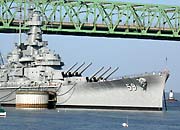
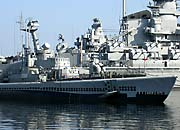
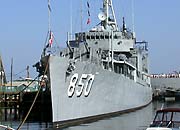
In the same building is another PT Boat, the Elco PT-617 which has been restored to a much higher standard. Also at Battleship Cove Naval Museum are the Submarine USS Lionfish, the Soviet Missile Corvette Hiddensee, the Destroyer USS Joseph P. Kennedy DD-780, and the Battleship USS Massachusetts BB-59. It's a great place to spend a day, and you'll need a full day to really see everything. Be sure to have lunch in the snack bar/grill in the galley of the Battleship. The food is not bad and you'll probably be as hungry as I was at lunch time after a few hours of climbing around warships.
Other Battleship Cove Naval Museum Exhibits |
|
|||||